
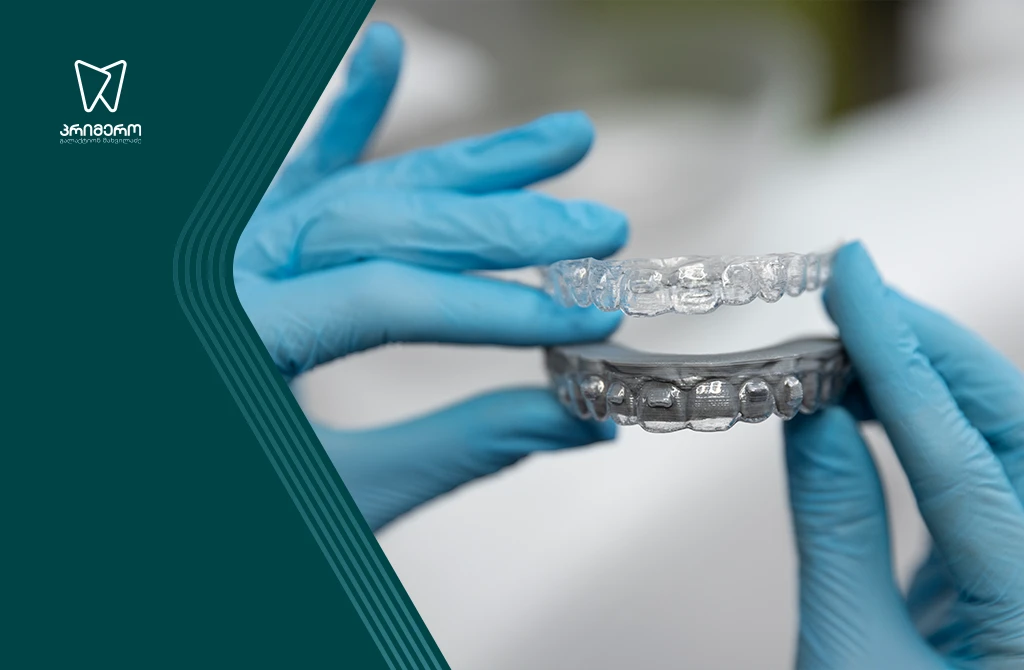
Patients often think that treatment ends once braces or other orthodontic appliances are removed, yet in reality teeth have a tendency to return to their original position. This is precisely why a retainer is prescribed: it is an orthodontic appliance that holds the teeth in their current position and preserves the result that has been achieved.
A retainer is one of the important stages of orthodontic treatment, which is why the experienced dentists at Primero devote as much attention to selecting and monitoring it as they do to treatment with braces and other types of appliances.
What is a retainer?
A retainer is a special appliance used to hold the teeth in place once treatment has been completed. Its main purpose is to maintain the new position of the teeth and prevent them from shifting.
Retainers became established in orthodontics from the twentieth century onwards. Years of research and practical experience confirmed that, without a retention stage, the result achieved often cannot be maintained reliably. For this reason a retainer is today considered an essential part of orthodontic treatment.
Initially, orthodontics mainly used removable metal appliances, which were effective but less comfortable and less aesthetic for patients. Over time, as technology and dental materials developed, retention systems were significantly refined as well.
Modern orthodontics makes active use of transparent trays, which are visually almost unnoticeable and cause the patient no discomfort at all in everyday life. Fixed retainers have also become widespread; these are bonded to the inner surface of the teeth and provide permanent stabilization.
How long should a retainer be worn?
How long a retainer needs to be worn depends on various factors, among them the patient’s age, the condition of the teeth, the complexity of the orthodontic problem and the likelihood of the teeth shifting.
In complex orthodontic cases, or when the teeth have a strong tendency to return to their original position, a retainer may need to be used for a longer period. The patient’s age also matters, since the process by which tissues adapt differs with age. This is exactly why the treatment plan is individual for each patient.
On average, the retainer-wearing period ranges from several months to several years. As a rule, the first 6 to 12 months are the most important: during this period the retainer is often used daily or almost constantly. At the next stage a removable retainer is frequently prescribed, which the patient usually wears only at night. Treatment with a fixed retainer, meanwhile, may continue for 5 to 10 years or even longer.
At Primero, one of the leading dental clinics in Tbilisi, we monitor the patient’s treatment process with the help of the latest technology, assess the tendency of the teeth to shift and take other important factors into account both before prescribing retainer treatment and afterwards.
What types of retainer are there?
Modern orthodontics mainly uses two types of retainer: fixed and removable. Each of them has its own advantages and its own specific purpose.
Fixed retainer
A fixed retainer is a thin metal wire bonded to the inner surface of the teeth. It remains permanently in the mouth and can be removed only by a dentist. A fixed retainer is particularly effective for stabilizing the lower front teeth, because it is in this area that the risk of the teeth shifting again is highest. One of its main advantages is that the patient does not have to remove and reinsert it every day, which reduces the likelihood of the regimen being broken. In addition, because it is bonded to the inner surface, the retainer is visually almost unnoticeable.
With a fixed retainer it is especially important to observe hygiene standards as thoroughly as possible, because food debris and plaque accumulate more easily around the wire. Cleaning such areas is comparatively difficult, which increases the risk of cavities, gum inflammation and calculus. If hygiene is not properly controlled, gum irritation, bleeding and an unpleasant odor may develop. This is precisely why the use of special brushes, interdental aids and floss is recommended, as these ensure that the spaces around the wire are cleaned thoroughly. Beyond daily care, regular check-ups and periodic professional cleaning are important.
Removable retainer
A removable retainer is a tray or a similar type of appliance that the patient can take out and put back in independently. The most widespread form is the removable retainer or tray, which is made from transparent material and fits snugly over the teeth.
The main advantage of a removable retainer is how simple it is to use and how aesthetic it looks. This type of appliance also makes it easy to observe hygiene standards, since it can be taken out while eating, brushing the teeth and carrying out other hygiene procedures.
As a rule, at the beginning of treatment the tray is recommended to be worn for almost the entire day, and later only at night. The retainer-wearing regimen is determined individually and depends on the complexity of the orthodontic treatment and on the risk of the teeth shifting.
A removable retainer should be cleaned regularly, because bacteria, plaque and tiny food particles may build up on the surface of the tray, which over time can cause an unpleasant odor, discoloration and problems in the oral cavity. Cleaning it daily with special products or a soft brush is recommended, so that the surface is not damaged. It is also important that the tray is always kept in a clean container and protected from high temperatures, since heat may deform the material.
During the retainer treatment period, regular visits to the dentist are important, because over time both the condition of the retainer and the degree of stability of the teeth may change. At these visits the orthodontist checks how well the appliance is performing its function, whether it has been damaged or deformed and whether it needs adjustment. Monitoring of this kind helps keep the achieved result stable and prevents possible complications in good time.
If you would like to receive high-quality orthodontic care, then visit us at Primero. Thanks to advanced technology, the latest methods and a qualified team, you will be able to receive precise and effective treatment, and as a result improve the health of your mouth and your smile.