
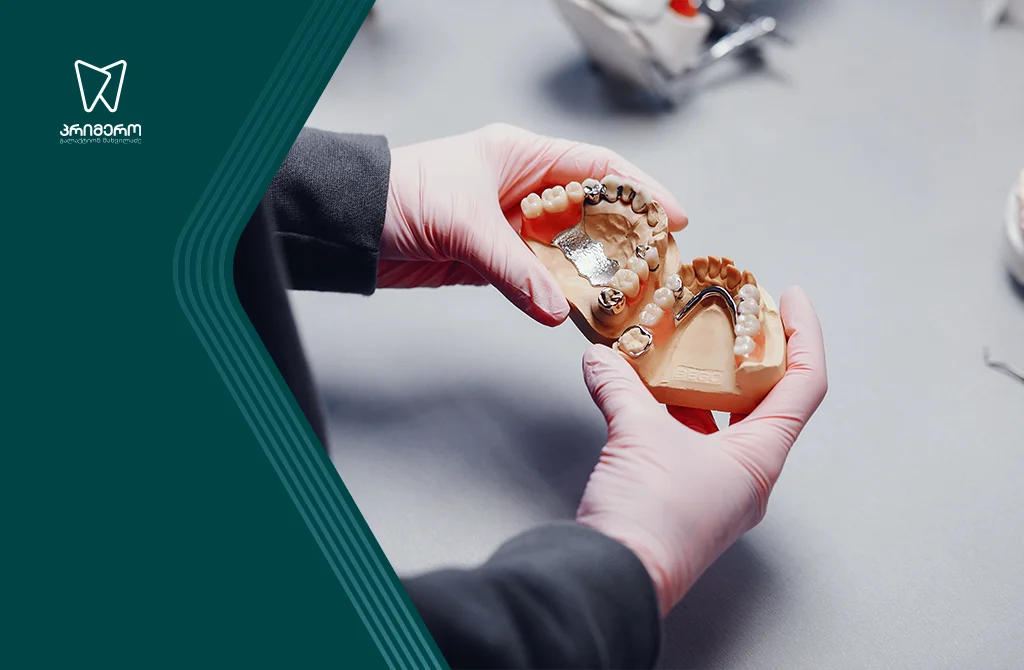
Healthy teeth define not only the aesthetics of your smile, but your general health as well. Missing or damaged teeth affect chewing, speech and facial proportions. This is precisely why prosthetic dentistry occupies a special place in modern dentistry.
At Primero, we devote a great deal of attention to this field. For us, prosthetic treatment is not merely an aesthetic procedure, and we approach it comprehensively. The restoration must be selected correctly, taking into account both the patient’s anatomical features and their individual needs. The quality of the materials used is no less important. Since a prosthesis is in constant contact with the tissues of the oral cavity and with food, it must be biocompatible, safe and durable.
What Is a Dental Prosthesis and Why Does It Matter?
A prosthesis is any orthopedic restoration used to restore a damaged or missing tooth. Its main purpose is to return the tooth’s function and stability, as well as to improve its appearance.
After tooth loss, the alignment of the remaining teeth changes over time and chewing function deteriorates. Atrophy of the jawbone may also develop, meaning a gradual decrease in bone volume and density. This happens because, once a tooth is lost, the bone no longer receives its natural load.
Other existing problems in the oral cavity often need to be resolved before prosthetic treatment. For example, if the patient has cavities on the adjacent teeth, it is advisable to place a dental filling first, because orthopedic restorations may complicate this procedure later on. In the presence of infection, root canal treatment is also necessary.
When selecting a prosthesis, assessing the overall condition of the oral cavity is equally essential. It must be determined how healthy the gums are, how the teeth are aligned, and what the state of the bite and the bone is. The point is that prosthetic treatment does not mean simply replacing a lost tooth. The restoration has to be properly integrated with the entire system of the oral cavity. When an incorrectly selected prosthesis is fitted, the load may be distributed unevenly, which can cause discomfort, chewing problems, gum irritation or damage to other teeth. A properly planned prosthetic treatment, on the other hand, ensures not only a natural appearance, but also comfort, stability and the durability of the restoration.
Before any prosthetic system is fabricated, preliminary modelling of the shape of the teeth is important. For this purpose, mock-ups and wax-ups are created. These are trial restorations that allow the patient and the dentist to assess the future result in advance, before the final prosthesis is made.
What Types of Dental Prostheses Are There?
Modern dentistry offers various types of prostheses, which differ in material and construction as well as in purpose. A correctly selected prosthesis ensures not only an aesthetic result, but comfort and durability too. The main types of prosthetic treatment are:
All-Ceramic Restorations, or Veneers
A veneer is a thin ceramic shell that is fixed to the front surface of the tooth. Its main purpose is to improve the shape, size, colour and appearance of the tooth.
Veneers are particularly popular in aesthetic dentistry, because they make it possible to change the smile with minimal intervention. With their help it is possible to close gaps between teeth, correct colour, restore a damaged or worn tooth, improve shape and symmetry, and more.
All-ceramic material resembles a natural tooth as closely as possible and retains its colour for many years. This is exactly why the veneer is one of the most sought-after prostheses.
Zirconium Oxide Crowns
Zirconium oxide is considered one of the most durable and biocompatible materials in modern dentistry. Its main advantages are strength, a natural appearance, an ideal fit with the gum and colour stability.
A zirconium crown is used to restore a significantly damaged or missing tooth.
All-Ceramic Restorations on Implants
A ceramic crown fixed on an implant is one of the best methods for fully replacing a lost tooth. In this case an implant is placed in the jaw, where it performs the function of a tooth root, and a ceramic crown is fixed on its upper part. Such a restoration:
- restores chewing function
- protects the jawbone from atrophy
- looks natural
- is distinguished by a long-lasting result
An implant is usually used when a tooth has been lost completely, although this method is sometimes applied when a tooth is severely damaged as well. A prosthetic restoration can no longer be reliably fixed on such a tooth, so it is sometimes necessary to extract the damaged tooth and place an implant instead, which ensures a more stable, durable and long-term result.
Removable Dentures
A removable denture is one of the most sought-after methods for restoring lost teeth. Thanks to modern materials and technologies, it is far more comfortable today than it was in the past.
Flexible removable dentures are especially popular. They are made from an elastic material and adapt easily to the shape of the oral cavity. A removable denture can also be temporary, worn by the patient for a short period only, until the permanent restoration is fabricated.
Removable Dentures Fixed on Implants
A removable denture fixed on implants is used when the patient is missing several teeth. This restoration is anchored to implants, which increases its stability and functionality. Unlike a conventional removable denture, it moves less during chewing and speaking, ensures better distribution of the load and gives the patient a more natural feeling of having teeth.
Fixed Zirconium Restorations on a Titanium Bar
This is one of the most modern and durable orthopedic restorations. It is fixed on implants and is based on a titanium bar covered with zirconium ceramic. This method is particularly recommended in cases of complete edentulism.
Its main advantages are maximum stability, durability, natural aesthetics and comfort.
Microprostheses
A microprosthesis is used to restore small and medium tooth defects in a way that preserves as much natural tissue as possible.
The methods of microprosthetic treatment are:
- Inlay – a microprosthetic insert used to restore the inner part of the tooth. It is appropriate when the defect is already too large for a filling, but full coverage of the tooth is not yet necessary.
- Onlay – a restoration that rebuilds not only the inner part of the tooth, but one or several of its cusps as well. This provides additional reinforcement of the tooth.
- Overlay – it covers a larger part of the tooth surface and is used to restore a significantly damaged tooth.
Caring for Your Prosthesis
Caring for a prosthesis is essential both for preserving the restoration itself for a long time and for the health of the oral cavity. Inadequate hygiene can lead to plaque build-up, bad breath, gum irritation and even damage to the prosthesis.
Specialists recommend cleaning the prosthesis daily with special hygiene products. Patients should also try to avoid hard foods and visit the dentist regularly so that the condition of the prosthesis can be checked.
In the case of removable dentures, storing them correctly is important too, so that they do not change shape or become damaged. In addition, the prosthesis may require adjustment or professional cleaning over time, because the condition of the oral cavity changes across the years. With proper care, modern prostheses retain their functionality and original appearance for many years.
Why Should You Choose Professional Dentists?
The success of prosthetic treatment depends on detailed diagnostics, correct treatment planning and the dentist’s experience. This is exactly why it is important to turn to a qualified dentist who, with the help of modern technologies and an individual approach, ensures safe treatment and a long-lasting result. You will find experienced dentists at Primero. Learn more about them and book your visit.
The clinic also uses materials of the highest quality and has introduced the latest digital technologies, which make the process of diagnostics and treatment considerably simpler. Together, all of this will allow you to regain not only your lost teeth, but your confidence and comfort as well.